
Deed Types in Milwaukee County
The Register of Deeds records any instrument that changes ownership or places a claim, restriction, or right on a parcel. The deed type hints at the deal. It cannot replace review of the parties, the legal description, and later filings. Milwaukee County indexes several transfer forms. Property can pass through a sale, an estate, a trust, a correction, or a distribution.
| Deed Type | What It Does | Common Use |
|---|---|---|
| Warranty deed | Conveys the grantor's interest with deed warranties stated in the instrument. | Commonly used for a sale; read the actual promises. |
| Quitclaim deed | Transfers whatever interest the grantor holds, without a warranty of title. | May appear in family, trust, or corrective transfers. |
| Personal representative or executor deed | Transfers estate property under the representative's authority. | Review alongside the probate order or file. |
| Trustee deed | Shows a transfer by a trustee acting for a trust or under a trust instrument. | Check the vesting language and related authority. |
| Correction or distribution deed | Corrects an earlier record or distributes property to a beneficiary. | Compare it with the prior document and legal description. |
A deed proves a conveyance. A mortgage, lien, easement, covenant, or restriction records a different interest entirely. The index reaches beyond deeds. Milwaukee County's land-record index also includes assignments, satisfactions, mechanic's liens, tax liens, lis pendens, certified survey maps, subdivision plats, and condominium documents. Some instruments, such as military discharges, are protected. Those special access rules mean not every instrument appears as an unrestricted web image.
Tapestry Fields for Milwaukee Deeds
Milwaukee County runs online deed searching through Tapestry on LandRecords.net. The form accepts parties, documents, dates, and land clues. Start with the likeliest single key. Adding unrelated constraints to an uncertain name search can hide the result, the county guide warns, rather than improve it.
| First and last name | Party names; use the business-name field for an entity and try indexed spelling variants. |
|---|---|
| Document number | Exact instrument reference when already known. |
| Document type | Dropdown for recorded instrument categories; live options may change. |
| Recorded date range | Beginning and ending dates narrow a party search. |
| Consideration | Dollar field for indexed consideration, where present. |
| Subdivision, lot, block | Plat and lot clues for a subdivision description. |
| Parcel number | Tax-key or parcel cross-reference. |
| Metes and bounds | Legal-description text where that description is indexed. |
The workflow is quick. Choose Search Now, pick Wisconsin, and pick Milwaukee County. Accept the user agreement. Enter payment details. A temporary $30 card authorization drops to the actual charges. The portal bills for the search and print pages. Certified copies come only from the county.
Open the Tapestry deed search to see the county selection and paid-search path. 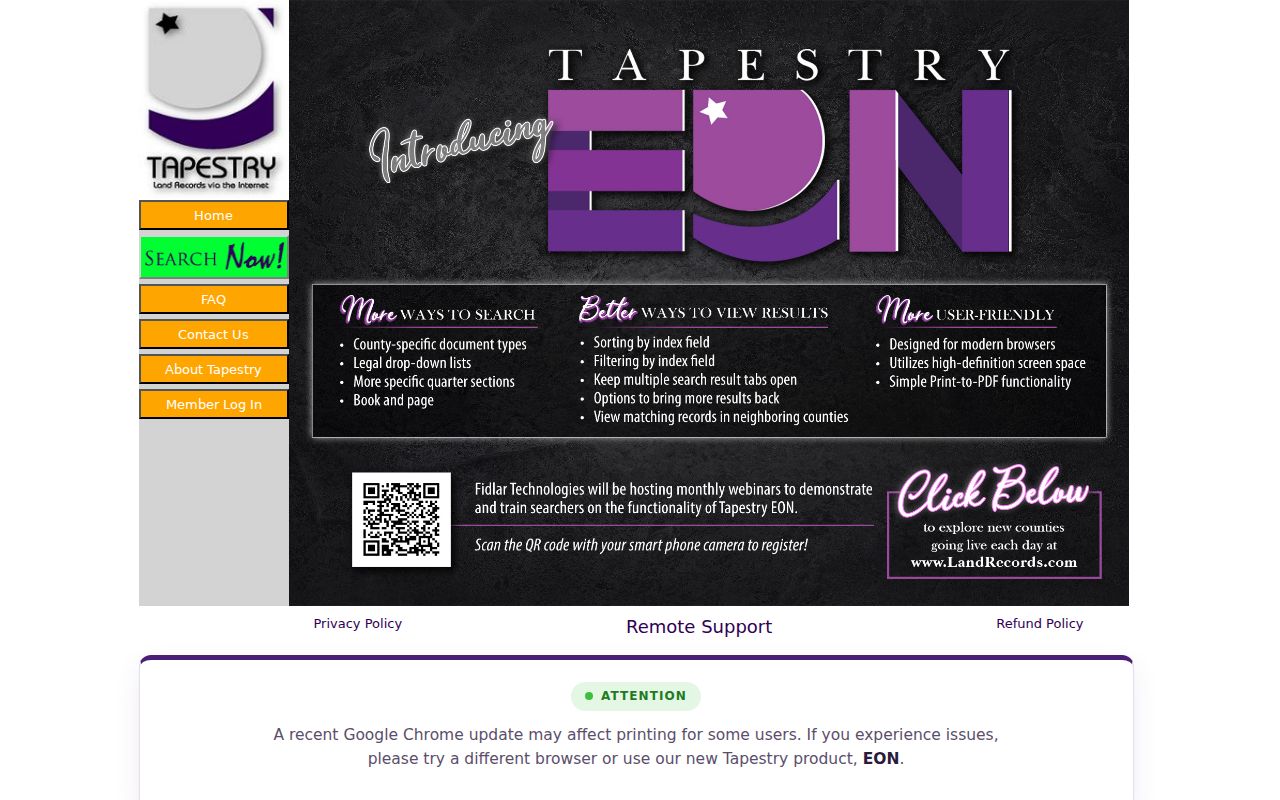 This portal view is the route to the indexed instrument; it does not turn an online image into a certified copy.
Milwaukee County Deed Search Time Ranges
Milwaukee County's historic images reach back to 1835, but the search mode depends on age and document type. The catch matters. Recordings from 1962 forward, including deeds from April 1, 1948 on, can be searched by grantor, grantee, tract, or document number. Older deeds are different. Deeds from 1835 through March 31, 1948 require an exact document number or a Book and Page citation. The images exist. A plain owner-name query may not surface them.
Plats have their own cutoff. Plats from 1835 through June 1991 need a document number or Plat Book and Page, while plats dated July 1991 forward answer to document number, grantor, grantee, or tract. Capture the reference on a known deed first. That reference is your bridge back. If the older index entry is not online by name, contact the Register of Deeds for complex historical research.
The Register of Deeds coverage and fee page lists current access methods.  Its coverage notes explain why an older deed may need a book-and-page or document-number key.
Reading the Grantor-Grantee Chain
A grantor conveys the interest. The grantee receives it. The index is only a name-based path, while the deed itself carries the property's legal description. Follow both party names and the land description. A seller may own more than one parcel in Milwaukee County, and an address may have changed over time.
- Find the newest deed and note the grantee, grantor, document number, legal description, and tax key.
- Search the grantor's name as a grantee in an earlier period.
- Compare the earlier instrument's lot, block, or survey description with the parcel in question.
- Repeat until the name search reaches its coverage limit, then use book and page or document number.
- Grantor
- The party named as conveying an interest.
- Grantee
- The party named as receiving an interest.
- Chain of title
- The sequence of recorded transfers tied to the same land.
- Book and Page
- A volume and page reference used for older Milwaukee County deeds and plats.
- Document number
- The recorded instrument's unique reference in the Register of Deeds system.
Digital Reel and Milwaukee Deed History
For property inside the City of Milwaukee, the Register of Deeds keeps Digital Reel. It is a tax-keyed grantor-grantee index. It runs from the 1920s through 1989, built on city assessor records. Digital Reel ties an old address to a parcel history. A changing owner name works too. Treat it as a finding aid: use the tax key to locate the recorded county instrument, then confirm the legal description in the deed or plat.
Historical work can also lean on Milwaukee Public Library directories, city tax rolls, plat books, and newspaper files. The Milwaukee City Clerk lists tax rolls on microfilm for 1958-2009 and electronic files for 2010-2023. A directory links an old street number to an occupant. The deed still proves the recorded conveyance. Older street numbering, a condominium conversion, a lot split, or a plat vacation can break a clean address trail.
The Milwaukee Public Library local history collection and Wisconsin Historical Society archives add address and neighborhood context. They complement, never replace, the land instrument.
Milwaukee County Mortgages and Liens
A deed is only one piece of the record. The land records hold mortgages, assignments, releases, and easements. They also cover covenants, judgments, tax liens, mechanic's liens, lis pendens, plats, and condominium documents. A recorded mortgage often picks up later assignments and, eventually, a satisfaction. A lis pendens tells you a lawsuit touches the land. The outcome of that case, and any release, live elsewhere.
Wisconsin Circuit Court Access (WCCA) can surface a foreclosure, lien-enforcement, probate, or quiet-title docket. It shows case information rather than the full file. To read the complaint, judgment, order, or satisfaction itself, request it from the Milwaukee County Clerk of Circuit Court. Match the legal description or tax key to the recorded land instrument.
Milwaukee DNS tracks its own side of things. A special charge, registration flag, or code-related lien can appear in a municipal title search. The city's title-search request runs separately from the county deed index. It carries a listed $50.80 fee.
Milwaukee County Deed Fraud Alerts
The Register of Deeds runs a free property-fraud alert program for Milwaukee County. Owners can register a name and get a notice whenever a document is recorded under it. The alert is only a warning tool. It does not block a recording, and it is not a title check. If an alert arrives, read the instrument closely, compare the parcel description, and call the office through its published number when a filing looks unfamiliar.
Fake government letters are another scam to know about. Some offer deed copies at inflated prices. Check the sender against the official county site, then compare the demanded payment with the county copy schedule. Milwaukee County also asks anyone who cannot find a Tapestry entry to call 414-278-4001 instead of treating a missing online result as proof that no record exists.
Copies of Milwaukee County Deeds
Tapestry provides paid images and prints, but certified copies come from the Register of Deeds. County copies cost $2 for the first page and $1 for each later page of the same instrument. Certification adds $1. A $10 search fee applies when the document number is not supplied; card payment adds $2.50 or 3%, whichever is greater.
For mail, identify the document type and number if known, state whether a certified copy is needed, and include the requester name, property address, phone, and payment. Requests are processed on receipt and mailed first class the next business day. In-person research is at 901 N 9th Street, Room 103, Milwaukee, WI 53233, Monday through Friday, 8 a.m. to 4 p.m. Complex ownership research requires an appointment at least 24 hours ahead. Staff guide the search but do not perform a title search.
The county real-estate records office is the source for current forms and fee details. For the backward chain across former owners, follow the process described on the Milwaukee County former-owner page.
Recorded, not guaranteed. The Milwaukee County deed index shows recorded instruments, not every possible claim or unrecorded interest. A title professional reviews priority and ownership for a transaction.