
Fields in Milwaukee County Tax Records
Every property tax record has two halves. The assessor's roll lists the parcel, owner of record, classification, and assessed value. The treasurer's account carries the tax bill, installments, special charges, payments, and any delinquency. Because Milwaukee County runs assessment and tax administration at the municipal level, the City of Milwaukee, Wauwatosa, West Allis, and other communities may each use a different portal with different field labels for the same data.
| Field | What It Shows | Where |
|---|---|---|
| Land, improvement, total | Separate assessment components and the total for the stated assessment year. | Municipal assessor roll |
| Owner and mailing address | Name and destination used for the tax bill; not a measure of occupancy. | Municipal assessor roll |
| Property class and flags | Class plus exemptions or special-status fields where that portal supplies them. | Municipal assessor roll |
| Tax bill and balance | Levy, installments, charges, credits, payments, and delinquency. | Municipal treasurer; county delinquent inquiry |
| Tax district | School and other taxing-district context used to calculate the bill. | Tax account and assessment report |
An assessed value is a figure for taxation. It is not an offer price. Wisconsin DOR publishes equalized and full-value comparisons across jurisdictions. Its ratio reports describe how a jurisdiction's assessments perform in aggregate. They do not promise that one parcel equals its latest sale price. The tax bill, likewise, is an account and levy statement only. It neither conveys the property nor proves that every recorded lien has been cleared.
Which Milwaukee County Office Bills the Parcel?
Milwaukee County contains 19 incorporated municipalities and no unincorporated town. That structure matters. The parcel's legal municipality decides the question of jurisdiction. It determines which assessor sets the local roll. It also determines which treasurer maintains the bill. A mailing city or ZIP code cannot settle the question. Check the parcel against the county's municipal boundary layer first. Then use that community's own assessment and tax channel.
The County Treasurer posts municipal tax contacts and a delinquent-property-tax inquiry and payment page. That county tool covers overdue balances. Ordinary bill and assessment history usually stays with the municipality. The City of Milwaukee runs its own tax-deeded property process. County listings cover tax-deeded properties from the other municipalities.
Keep three identifiers together: the tax key, the situs address, and the municipality. If a portal rejects the address or returns a neighboring parcel, open the MCLIO boundary map. Then call the local assessor. Paying or appealing against the wrong account is an avoidable mistake.
Milwaukee County Assessment Timing
The City of Milwaukee updates real-property assessments every year in mid-April. The appeal deadline falls on the third Monday in May. Because of that annual cycle, a value notice can arrive before a newly recorded transfer reaches the assessor's owner field. The recorded deed and the tax roll may briefly name different parties.
Assessment timing and tax-bill timing are separate events. The assessor estimates taxable value and maintains parcel classifications. The treasurer applies the levy, installments, credits, charges, and payment status. A shift in assessed value does not reveal the final amount due. A payment entry does not revise the deed.
Other Milwaukee County municipalities follow their own calendars. Confirm open-book dates and filing instructions with the local office. Do not apply Milwaukee City's schedule to every parcel.
Milwaukee County Delinquent Tax Records
A delinquent balance is a tax-account status, not a completed transfer. Read the tax year, installment, special charges, penalties, and payments. Then check for a separate foreclosure, court judgment, sheriff's sale, or tax deed. The Milwaukee County foreclosed-property listing covers county-acquired residential, commercial, and vacant land. It lists property details and purchase requirements. It excludes properties handled through the City of Milwaukee process.
A possible tax transfer needs three records compared. The treasurer's account shows the balance. WCCA shows any court case or judgment. The Register of Deeds holds the recorded tax deed or sheriff's deed. A tax bill alone cannot establish that every step occurred. Match any deed or court order to the account by legal description and tax key before linking them.
The county listing page may be down, or a property may not appear. Contact the municipal tax office or the County Treasurer in that case. An unavailable web page is not evidence that no delinquency or sale record exists.
Finding a Milwaukee County Tax Bill
Open the municipality's property or tax portal for the current bill. Then follow its links to prior-year payment information. Wauwatosa's portal shows tax information dating to 2006. It accepts either a parcel number or an address search, and separates current from historical properties. Once a result opens, its Taxes tab displays the tax information. County Payment/Balances leads to prior-year payment data.
- Confirm the parcel's municipality and copy the tax key from its assessment card.
- Open the municipal tax portal and search by the address or parcel mode it supports.
- Read the bill year, installment, charges, credits, payments, and balance together.
- Use the county delinquent inquiry for an overdue account, then verify any claimed sale in court and deed records.
- Assessed value
- The municipal assessor's value for the parcel in a stated assessment year.
- Equalized value
- A Wisconsin DOR measure used to compare aggregate municipal assessments with estimated full value.
- Tax levy
- The amount imposed by the taxing authorities and applied through the tax bill.
- Delinquency
- An unpaid balance or installment shown in the tax account, not proof of a deed transfer.
Wauwatosa's portal shows how a local tax screen connects parcel, bill, and prior payment fields. Open the Wauwatosa property and tax search to view its public entry point. 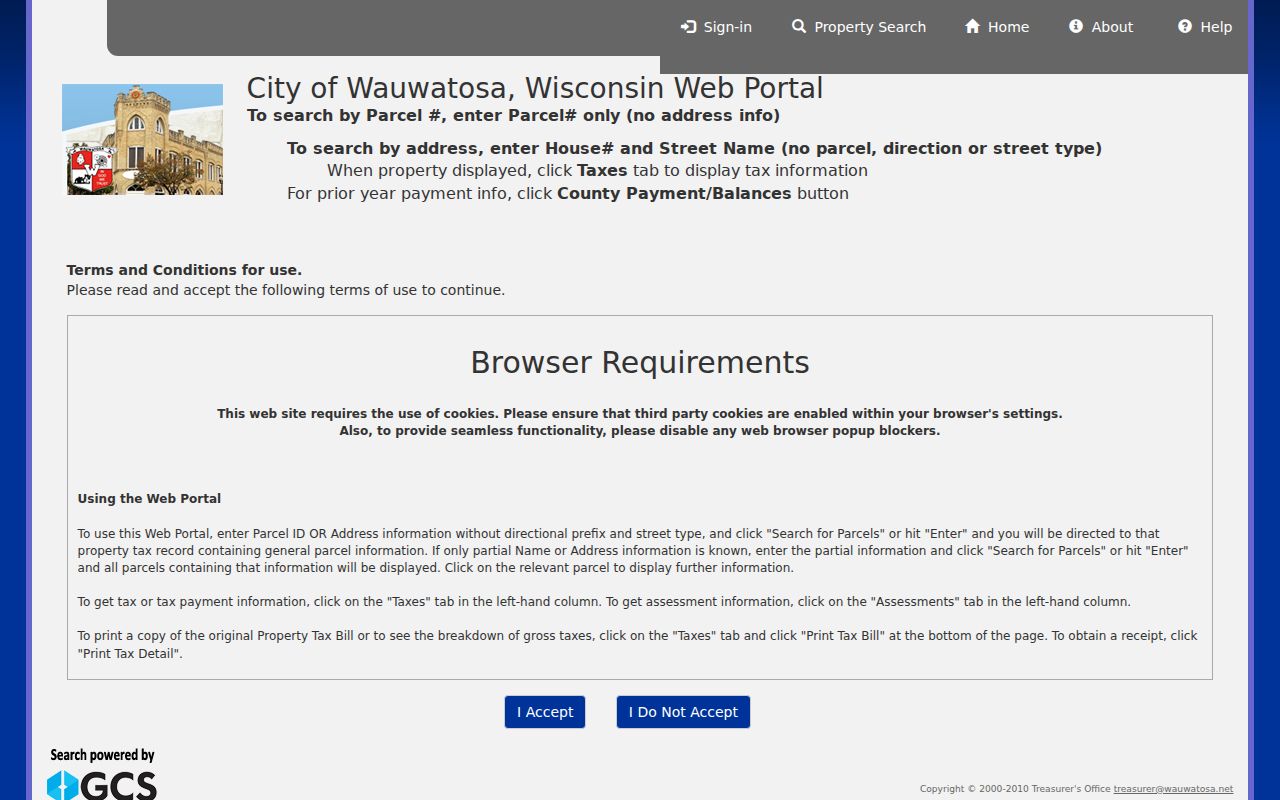 The search controls are municipal, while county deeds remain the source for a recorded ownership transfer.
Older Milwaukee Property Tax Rolls
Older tax rolls show a parcel and its assessed name at a given year, but they never replace the deed chain. The Milwaukee City Clerk keeps microfilm rolls covering 1958 through 2009. Electronic rolls follow for 2010 through 2023. A dated roll can bridge an old address, a variant owner-name spelling, or a tax-key change that today's assessor page no longer shows.
Permits and tax rolls sit in separate channels. The roll dates an assessment. The permit record explains why the building changed. For deeper parcel work, pair the roll with the recorded lot and block, city directories, and a deed instrument from the Register of Deeds.
Wisconsin Public Records Law, Wis. Stat. §§ 19.31-19.39, lets anyone request records from the government custodian, subject to specific exceptions and the balancing test. Describe the parcel, the years, the record type, and a preferred electronic format. The custodian must respond as soon as practicable and without delay. Wisconsin sets no single universal response-day count.
Milwaukee County Tax Keys and Prior Bills
A Milwaukee County tax account hangs on the municipality's parcel key. It does not hang on the street address alone. Splits, combinations, condominium conversions, and renumbering can all occur. These can leave the current key pointing to only part of the history. Compare the tax account's prior-year view against the assessor property card. Write down both the old and current keys. Do this before asking for a paper bill or payment ledger.
Local offices handle current property taxes. Delinquent balances run through a separate county inquiry and payment route. Each document answers a different question. The bill states the levy and its due installments. The payment record shows credits or unpaid amounts. The assessment notice gives the value behind the levy. Keep the tax year and municipality attached to every figure. Otherwise an old account can masquerade as today's balance.
Appealing a Milwaukee County Assessment
In the City of Milwaukee, the assessor's annual notice states the assessment. The published appeal window closes on the third Monday in May. Start with the city's assessment and appeal information. Follow the open-book and Board of Review instructions for that cycle. File the forms or use the contact route supplied for the year in question. The countywide label is loose; not every suburb follows this calendar.
Line up parcel evidence before filing. Compare land and improvement values. Note the assessment year and class. Collect recent property details or comparable sale information that speaks to the parcel's condition. Put the municipal tax key on each item. A recorded sale price proves one transaction happened. It does not by itself prove the current assessment is wrong.
Wisconsin DOR's 2025 reports publish municipal aggregate ratios and major-class comparisons. The state's compliance standard asks each major class to fall within ten percent of full value in the same year. That must happen at least once over a five-year period. That test judges the jurisdiction as a whole, never a single property.
Appeal window. Milwaukee City's published 2026 cycle uses the third Monday in May; confirm the current notice and local Board of Review instructions because other county municipalities set their own procedures.
The City Assessor's appeal and exemption page carries that city's current dates and forms. For the difference between assessed and sale value, see the Milwaukee County property-value page.